

Diamond treatments and what a seller should disclose
When the FTC says a treatment should be disclosed, and what to ask.
Disclosure: We may earn a commission if you buy through links on this page. It does not change our guidance. Affiliate Disclosure
Ask first
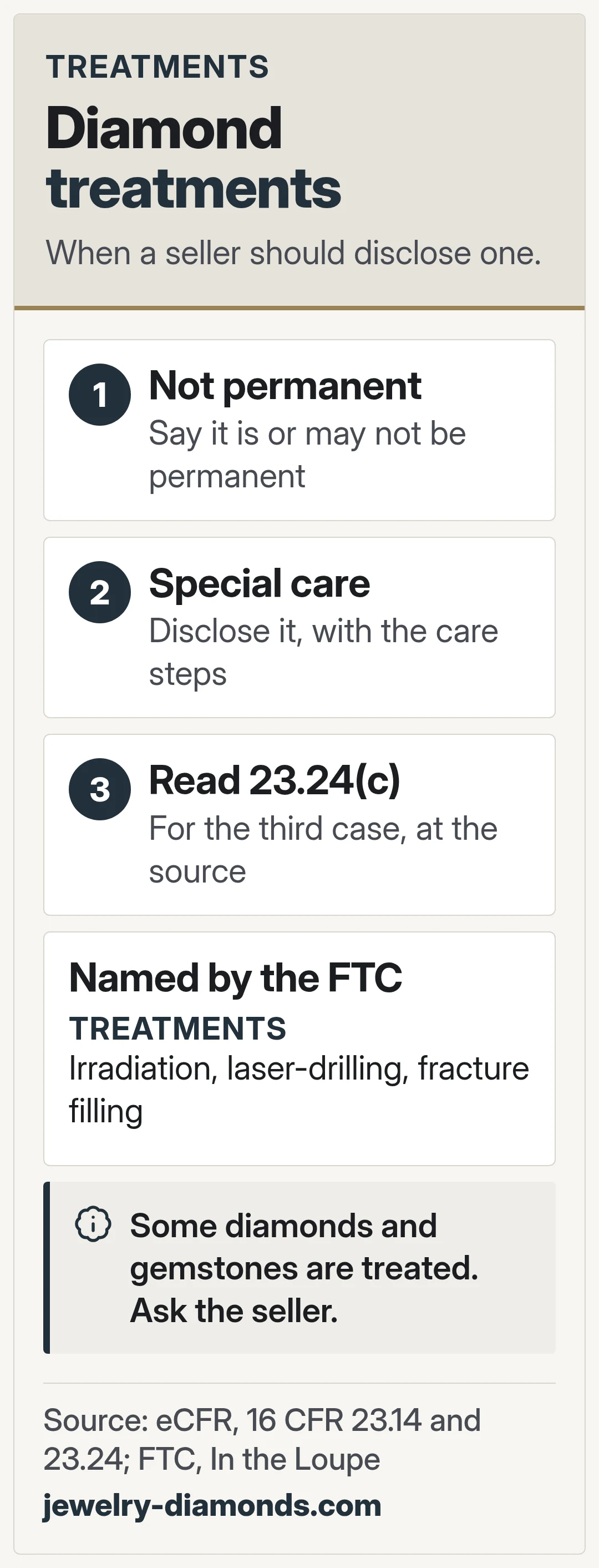
Some diamonds and gemstones are treated. Ask the seller and read the description and report. We never say any stone is free of treatment.
The gemstone rule applies
Section 23.14 says a diamond is a gemstone product, and that treatments to diamonds should be disclosed as section 23.24 sets out for gemstones.
When to disclose
Section 23.24 says a seller should disclose that a gemstone has been treated if the treatment is not permanent, and say that it is or may not be permanent; or if the treatment creates special care requirements. Section 23.24(c) adds a third case; read it at the link below.
Diamond treatments the FTC names
The FTC lists irradiation, which can add color to colored diamonds, and laser-drilling, which removes dark inclusions from diamonds. It also lists fracture filling, in which colorless plastic or glass is injected to hide cracks or fractures.
Online listings
A note to section 23.24 says that where a product can be bought without seeing it in person, such as online, the disclosure should be in the solicitation for, or description of, the product.
Care
The FTC says that if ultrasonic cleaners or solvents should not be used on a treated stone, the seller should say so and name the cleaners or solvents to avoid.
FAQ
General information only. We are not a jeweler, appraiser, or gemological lab, and we do not grade, appraise, or verify any stone or metal. Before you buy, read the seller's full description, including whether a diamond is mined or laboratory-grown, any treatment, the metal's karat or fineness, and the weight, and check any grading report with the lab that issued it.



Next: gemstone treatments
The treatments the FTC lists.
