

Platinum 950 and other platinum marks
What 950, 900, 850, Pt, and Plat. mean in a listing.
Disclosure: We may earn a commission if you buy through links on this page. It does not change our guidance. Affiliate Disclosure
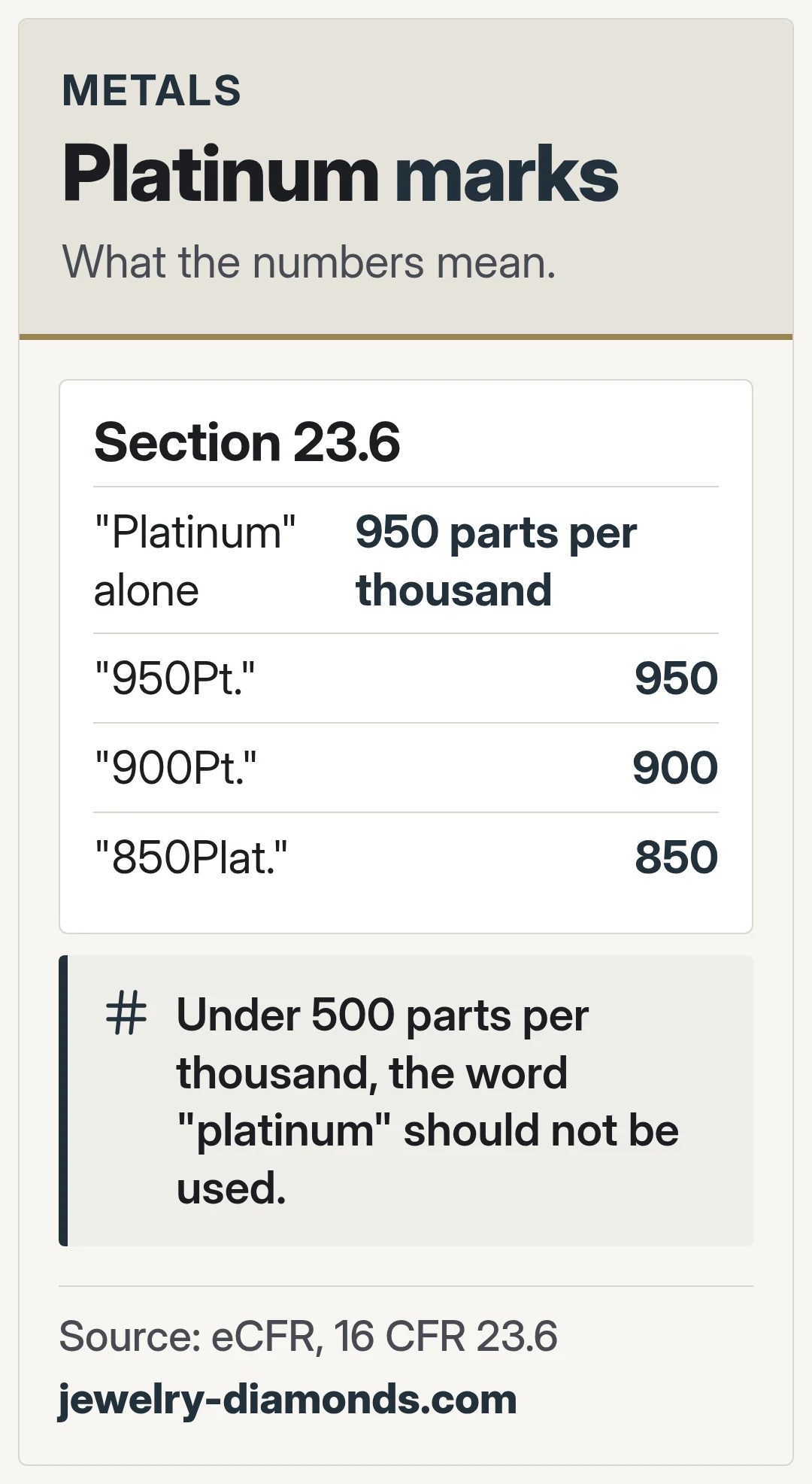
"Platinum" alone means 950
Section 23.6 says the word "platinum", without qualification, should describe only a product composed throughout of 950 parts per thousand pure platinum.
Number marks
Under section 23.6, products of 850, 900, or 950 parts per thousand pure platinum may be marked with the number first, such as "950Pt.", "950Plat.", "900Pt.", or "850Plat.". The Guides list "Plat." and "Pt." as abbreviations for platinum.
Platinum group metals
The Guides name six platinum group metals: platinum, iridium, palladium, ruthenium, rhodium, and osmium. A product with at least 950 parts per thousand of them, and at least 500 of platinum, may be marked with each metal's number, for example "600Pt.350Ir."
Lower platinum content
Section 23.6(b)(5) says platinum should not describe any product with less than 500 parts per thousand pure platinum. Between 500 and 850, the Guides call for the full composition and other disclosures; read section 23.6(b)(6) at the link below.
Coatings
Section 23.6 says a product that only has a platinum surface layer should be described as only coated. Section 23.7 says a surface layer of rhodium should be disclosed on products described as precious metal.
FAQ
General information only. We are not a jeweler, appraiser, or gemological lab, and we do not grade, appraise, or verify any stone or metal. Before you buy, read the seller's full description, including whether a diamond is mined or laboratory-grown, any treatment, the metal's karat or fineness, and the weight, and check any grading report with the lab that issued it.



Next: stamps and marks
How to read a quality mark.
