

Diamond simulants, imitation stones, and testers
Stones that look like a diamond but are not one, and how they should be named.
Disclosure: We may earn a commission if you buy through links on this page. It does not change our guidance. Affiliate Disclosure
Imitation and simulated
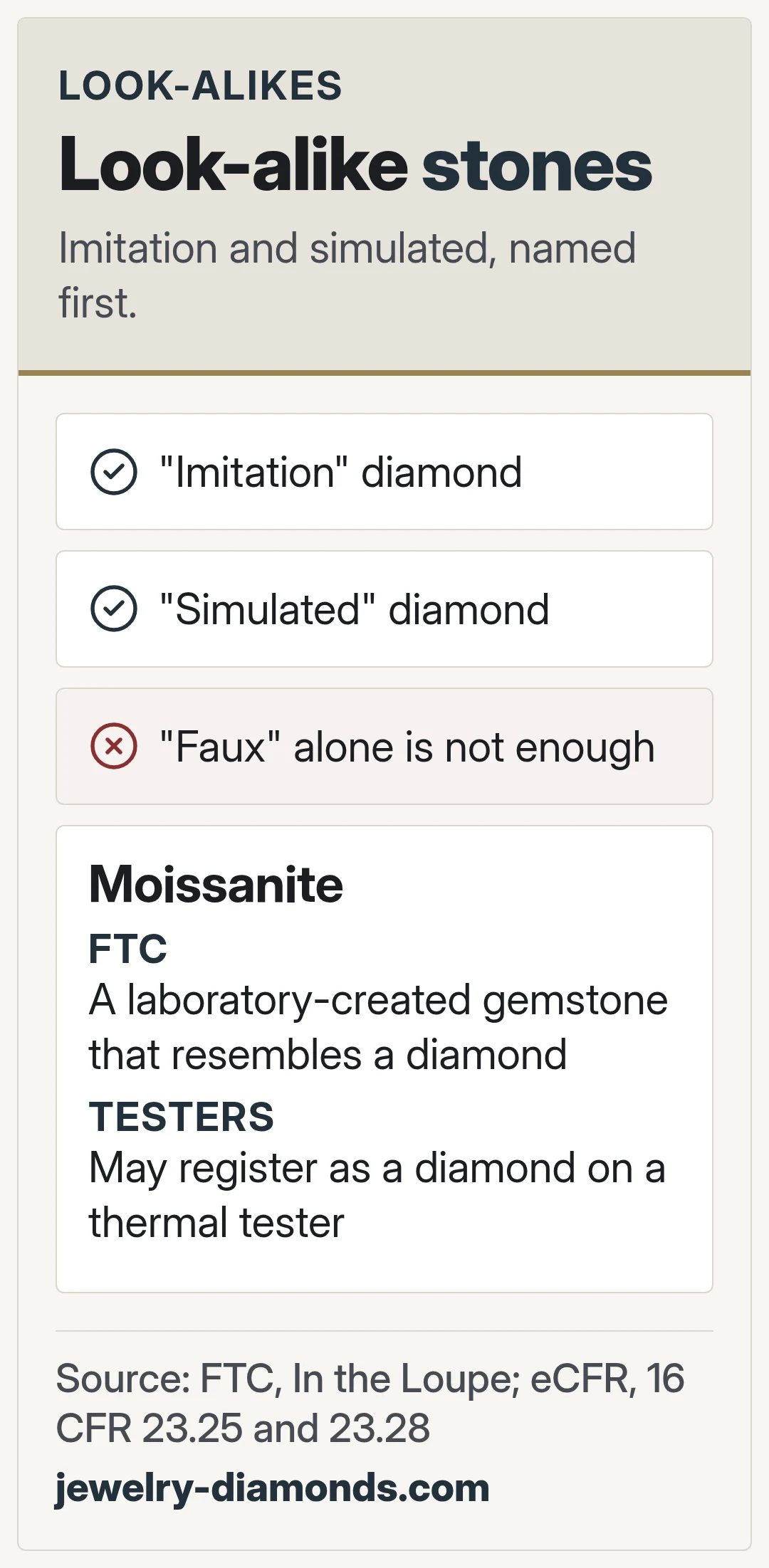
The FTC says a seller of imitation or simulated diamonds should describe them as "imitation," "simulated," or a word of like meaning, immediately before the word "diamond" and equally conspicuous, to show that the product is not a laboratory-created or mined diamond.
"Faux" is not enough
A note to section 23.25(b) says "faux" is not an adequate disclosure for an imitation stone.
Moissanite
The FTC describes moissanite as "a laboratory-created gemstone that resembles a diamond."
Testers
The FTC says thermal testers used to distinguish diamonds from cubic zirconia may not accurately identify moissanite, so moissanite may register as a diamond on a thermal tester.
Gem words
Section 23.25(b) says the words "stone", "gem", and "gemstone" should not describe an imitation or simulated stone unless "imitation" or "simulated" comes immediately before, with equal conspicuousness.
Grading words
Section 23.28(c) says imitation gemstones should never be described as "flawless" or "perfect".
FAQ
General information only. We are not a jeweler, appraiser, or gemological lab, and we do not grade, appraise, or verify any stone or metal. Before you buy, read the seller's full description, including whether a diamond is mined or laboratory-grown, any treatment, the metal's karat or fineness, and the weight, and check any grading report with the lab that issued it.



Next: laboratory-grown diamonds
A diamond, named as laboratory-grown.
